The Change Arranger
Tuesday, 7 August 2012
Perseverance
Monday, 15 August 2011
What I Learnt From My Dad
Watching the rioting and looting on the news last week, I reflected on what was going on. Plenty of other people have said some useful stuff about punishments and about causes, and quite a few have mentioned the breakdown of the family as a cause. Many young men now grow up without fathers. I was lucky enough to have a father who stayed with my mother until he died. This is a little of my experience of him.
It’s important to point out that he didn’t have an easy or privileged life. He grew up on a subsistence farm in Canada and had only limited schooling. He returned to the UK and joined the Royal Navy at aged 15. He married my mother at 20 and at 22 he was wounded at Dieppe and lost his right leg and suffered many other injuries. That was the same year my eldest brother was born.
My dad was tough. He stuck with things and didn’t give up. My dad always worked. He did factory work for most of his life, until he moved to Cornwall and started a landscape gardening business at 50 years of age. I learnt from my dad to work hard to get what you wanted.
My dad had authority in our family. In an age when getting a smack from mum or dad was pretty normal, my dad never hit me. We would get a sharp word, especially if we were disrespectful to my mother, and occasionally the threat of a clout, which actually never came. He was also able to allow us to rebel up to a point. He was protective. He supported my mother in parenting three lively boys, who became unruly young men, but we knew not to overstep the mark with her or he would step in. However, when an adult neighbour was rude to me, he went straight next door and had a strong word with him about it.
He was a regular but sensible drinker, and when I was a teenager he would take me to the pub. There I learned that grown men might become more or less intoxicated, but it was a matter of pride to hold your drink, know your limits and continue to behave properly, not foolishly or aggressively. There was always enough money to pay the bills – visits to the pub came after everything was paid and there were savings for an annual holiday at the seaside. We didn’t owe anyone anything.
My dad was respectful of women. He deferred to my mother in a range of important ways. He understood that she was well organised and a good manager of finance and household matters. He understood that her wage, whilst less than his, was an important component of the household income. He respected her as a partner who was different but equal. What he wasn’t good at, he would ask my mother to do, because he trusted her. In some areas she was the dominant partner in their marriage.
He valued education. We were working class and lived in a council house. Neither of my parents was very well educated, having left school quite young in the 1930s to go to work. He always exhorted me to work hard at school. I was to respect my teachers and do my homework. He understood that it was the way out of poverty and the limitations of class.
He encouraged me to develop skills. He took me fishing and shooting, and I had a little boat on a nearby gravel pit. He bought it but I had to maintain it. He was also generous. He always had a few shillings in his pocket as a treat, and was the first to offer to pay for meals and drinks. Even when I visited home as an adult, he would press money on me when I left “to help towards the petrol”.
My dad loved me. I miss him. He probably wasn’t the world’s best dad, he was a long way from perfect, but he was the best he knew how to be. If I had smashed things up or robbed shops, if I had rioted in the streets and been taken to the magistrates’ court, it would have shamed him. I wouldn’t have done that, because I loved him.
Single mums do a really difficult job, and mostly they do it pretty well, with toughness and dedication, but as boys become men they need ways to channel their strength and energy in a healthy way. At risk of being old-fashioned, that’s not women’s work, it’s men’s work, it’s a father’s job to show them how it is done.
Sunday, 31 July 2011
Ten Useful Life Rules
As an older person I have the advantage of having had enough successes and made enough mistakes to have learned from them. If you look at your own life and those around you, you can extract principles from the learning. I have ended up with a kind of personalised Desiderata. These are my current favourites.
1. When you make a decision, check out whether you are in an adult, rational state, or an impulsive, childish state. Impulsive decisions tend to be the ones that you regret making. If you are not sure, talk your decision over with someone else. Other people, who are less involved in the process than you are, are more likely to make rational, adult suggestions.
2. If you want to achieve something, imagine and believe in the outcome. Have a vivid picture of what you want in your mind. Think about it constantly. It will make it much easier to achieve. If you stop believing, you will probably stop taking effective action, and vice versa.
3. When you start something, follow it through to the end. Many of us have failures which are simply cases of stopping before the enterprise is finished. If you must stop, do not do it on impulse. If you reconsider the enterprise with rational, adult common sense and decide on that basis to change your commitment then do so, otherwise stick with it.
4. Remember to speak as kindly as possible about others at all times. Difficult situations arise, and you may have a strong view, or a side to pick in a dispute, but unkind words can come back to haunt you. Do not sit on the fence or avoid commenting honestly, but balance your views with a calm reflection. Be careful what you write, or commit to electronic media. Casual remarks or inappropriate jokes will be available for all time, even though the context is long gone.
5. If you are lucky enough to fall in love, be careful not to make irrevocable decisions and commitments for the first three – or ideally the first six – months. The heady mix of chemical bonding, sex, unconscious attractions, and a natural longing for togetherness does not make for a reliable state of mind for making choices about your future.
6. Being in love is wonderful, and the longer this state can be maintained the better. However, sometimes loving someone is an action you take out of care and commitment rather than a nice feeling. If we truly love, then we love people even when the going gets tough.
7. In an ideal world, our parents would be perfect role models. Most of us have normal, imperfect parents who were simply doing their best. One-parent families often model strong women who spend their time alone, and absent fathers who have limited influence on their sons and daughters. The results can often be strong lonely women and uncertain men who don’t feel a match for them. Seek people in addition to your parents to admire and model yourself on.
8. Be honest. It’s easier on the memory, and if others don’t like what you say that is their choice. You are not “upsetting them”; they are choosing to get upset. Learn to speak from the heart. Intimacy is a skill which is vital in relationships, and goes far beyond our sexual activity.
9. Learn a little about the mechanisms of human thought and feeling. Transactional analysis - ego states, the drama triangle and the games people play - is helpful and accessible. http://www.businessballs.com/transact.htm and http://www.businessballs.com/transactionalanalysis.htm are useful links.
10. In life, work, money and love, be a chooser wherever possible. You are much more likely to get what you want. The chosen usually gets what someone else wants.
Friday, 20 May 2011
CSP Coaching’s first Diploma Weekend
Last weekend was the first weekend of our Life, Business and Executive Coaching Diploma at University College of St Mark and St John. This is what some of our course participants had to say:
The weekend provided me with quite a few "ah-ha" moments. The group of people were fantastic and I'm really looking forward to continuing to work with all of them. I was amazed how much stuff (technical term!) we studied without any of it feeling like "work" - it was fun! - JH
I would describe the weekend as a life-transforming event for me. Finding out new things and new ways of looking at the world, relationships and problems and how to deal with them in a solution focused way was amazing and something I wish I'd looked at many years ago! It was a joy to learn in such a safe and welcoming environment and I felt excited and inspired to learn more....came away which lots of knowledge which I didn't know had been given to me due to the interactive, humorous and interesting teaching styles of both Alan and Steve. Also a fantastic way to meet like-minded people and to form a whole new set of friendships and acquaintances. A very worthwhile experience and looking forward to the rest of the course with relish as well as enjoying the daily coaching on myself via my log. Thank you. - SG
The weekend was fast paced, with so much knowledge and information to absorb, that it seemed to be over in a flash. I am still digesting my notes, have already had my first coaching session and preparing to coach my first 'client', how amazing! The highlight of my weekend was to meet some genuine people to share the start of a new journey, none of us know where it will lead, and I am so looking forward to seeing how our various routes develop. I miss you all and look forward to our next session together. - LA
Really enjoyed the weekend, thought the group jelled really quickly and we all got on really well. I particularly enjoyed the ‘words, pictures and music’ session - fascinating to see how these three mediums can manipulate your mind and mood. I also enjoyed the Gilmore Group session – thought everyone did really well; it was a good indicator as to how much we had all learnt over the three days. Looking forward to my first coaching sessions tomorrow and our next group weekend in June. – CR
Sunday, 6 March 2011
A New Children's Story.
A little girl in primary school underwent chemotherapy for leukaemia. When she returned to school, she wore a scarf to hide the fact that she had lost her hair. But some of the children pulled it off, and in their nervousness laughed and made fun of her. The little girl was mortified and that afternoon asked her mother not to make her go back to school. Her mother tried to encourage her, saying “The other children will soon get used to it; anyway your hair will grow back again soon”.
The next morning, when their teacher walked into class, all the children were sitting in the seats, some still tittering about the girl who had no hair, while she shrank into her chair. “Good morning children,” the teacher said, smiling warmly in her familiar way of greeting them. She took off her coat and scarf. Her head was completely shaved.
After that a rash of children begged their parents to let them cut their hair. And when the child came to class with short hair newly bobbed, all the children laughed, not out of fear but out of joy in the game, and everybody’s hair grew back at the same time.
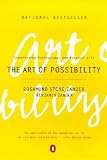
The Art of Possibility, Zander and Zander
| The Art of Possibility |
Sunday, 27 February 2011
From Spark to Fire
It can take only a spark, a carelessly dropped cigarette, to start a great forest fire. Yet how many of us have tried to start a fire in the garden or a fireplace, and struggled to get it going? The paper is damp, or the kindling won’t catch, or the wind is too strong – it can be very frustrating. In times gone by, before the days of lighters, safety matches and barbecue fluid, travellers would carry a few hot coals in a clay pot, along with some dry kindling, so that they could start a fire quickly wherever they stopped. They would add the coals to the kindling, which they would then blow on to get a quick flame which would spread to the wood they had collected.
Sometimes it can be hard to get a spark started in yourself. Have you ever had a great idea for a New Year’s resolution, only to find that the fire has gone out by the 3rd January? Have you ever sat looking at a project which you know needs to be done, and you want the results, but you can’t seem to get started? I certainly have. That’s the time that we need to start a fire in ourselves, to blow on the coals and add dry kindling, so that we start to burn with enthusiasm and energy. Wouldn’t it be great if you could do that to order?
A coach’s job is to be able to start that fire in her clients, and to be able to do that she needs to do it in herself first. We can all be fired up at one time or another, but the coach needs to be able to get fired up to order, not when he feels like it. His client needs him to have fire, energy and enthusiasm on tap.
This week we will be holding another of our successful Coaching Taster Days in Plymouth. Come and join us to fan the flames. The theme will be the same as this blog post – From Spark to Fire – and throughout the day we will be referring to the need to be able to start your own fire so that you can ignite the fire in others. Coaches need to breathe energy, to breathe air onto the fire of enthusiasm of their clients.
If you’d like to learn more about this, call me on 01752 664429 or email alan@cspcoaching.com to reserve a place on the next free taster day on March 5th.
Thursday, 17 February 2011
Making a Difference
Every year we make those New Year Resolutions, and you might be wondering why I am mentioning them – after all, most people gave up on them weeks ago.
We are creatures of habit, and we evolved in a dangerous world to be in survival mode. That often meant that we had to learn habits and methods, and keep things the same wherever we could. Five thousand years of civilisation has not made much of a dent in a million years of survival thinking, and we carry on keeping everything the same, and our resolutions to change usually come to nothing.
Last Saturday CSP Coaching - my partner Steve and I - held a Coaching Taster Day, and we hosted a group of ten people who were interested in Life Coaching and in our new Diploma. That’s where making a difference comes in. We spent time on the methods and approaches of coaching, and how theories of learning have influenced coaching, but the main thrust was to answer the hard question: How do you create lasting change? This is our biggest challenge, and unless we can make change last then it’s of little value.
I think that we cannot change unless we can have real belief in the possibility of change. I like to imagine how it was for those people who were first faced with the idea that the world was round, not flat. How hard it must have been to understand and believe in that! How terrifying it must have been to head off on a small ship, wondering if you’d got it wrong, and you’d sail off the edge of the world! In these days of air travel and photographs from space it’s fairly easy to see, but in the 15th century this idea was a real challenge.
I hope that I was able to help the group to believe that lasting change is possible, and for it to happen we have to change our beliefs and transform the way we think and feel. I know that some of them were sufficiently convinced that they have committed to our course, and I think that they all had a good time and learnt something in the process. I hope overall, that the day made a difference to their lives and to how they see the world. If you’d like to find out about or attend the next Taster Day, email alan@cspcoaching.com, or call me on 01752 664429, or click here.